Reinvention – A Major Challenge in Alignment
The term reinvention is relatively new to the business lexicon. However, with the rapidly accelerating rate of change in the business environment, it must always be at the forefront of every executive’s mind. Studies show that the time frame between a necessary reinvention of one’s business is rapidly decreasing. All one has to do to verify that reality is to observe all the more recent bankruptcies in retail firms, in restaurant chains, manufacturing companies, etc. to recognize that companies must always be alert to the need to reinvent themselves.
There are many reasons why companies fail to reinvent. The most prominent is the lack of awareness of the need to do so. But even if senior executives are diligent about pursuing reinvention for their business, there are major hurdles that must be overcome to achieve success. One of the major hurdles that we have discussed is the ability to utilize proper experimentation which we have reviewed in the use of a Proof Point Process. Another major hurdle, however, that is often overlooked is the need to fully realign one’s business when in the process of pursuing a major reinvention.
Realignment – The Most Overlooked Hurdle
All reinvention begins with a major change in some element of the business. It could be a major change in strategic direction. It could be a significant shift in business model. It could be a dramatic restructuring of key processes and systems – something that is becoming more prominent with the advent of AI. Whenever this is initiated, there is an acknowledgement that a few things in the organization need to change to accommodate the reinvention initiative.
What is often missed, however, is the degree of change and the fact that most of the elements of the business need to undergo some change. In other words, almost every element of the business must change to be aligned with a major shift in direction.
The Elements of Alignment and Congruence
To fully understand the key aspects of alignment, there must be an understanding how all the organizational and business elements relate to each other. One of the initial efforts at doing this was the McKinsey 7S Model. That model listed elements such as strategy, structure, and systems and asserted that they were interrelated. It was some of the first recognition of how these various elements are intertwined and interdependent.
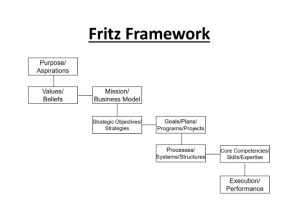
Since that time, we have developed a more in-depth model and have learned more precisely how these elements interrelate. We have identified eight groups of elements that fall into four dimensions that define every developed business. We list these in a particular order because it illustrates exactly how they interrelate and align with each other.
Specifically the eight groups and what they represent are:
Purpose and Aspirations – Why do we exist? What do we want to become?
Values and Beliefs – What values do we live by? What are the critical beliefs that guide us?

Mission and Business Model – What are our primary missions? What business model(s) do we employ to deliver on those missions?
Strategic Objectives and Strategies – What longer-term objectives will tell us if we are successful? What are the primary strategies that we are going to employ?

Goals, Operational Plans, Programs, and Projects – What are the goals, plans, programs, and projects that support the strategies and the mission?
Processes, Systems, and Structures – What are the operational processes, systems, and structures that need to be in place?
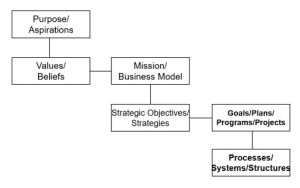
Core Competencies, Skills, and Expertise – What competencies and skills do we need to develop? What expertise do we need to develop or access?
Execution and Performance – How do we execute, monitor our progress, and mid-course correct when necessary? How do we adapt when required to by changes in the environment?
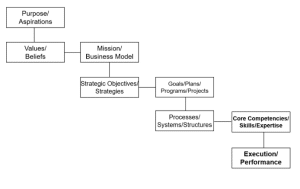
We have found that these elements naturally fall into four key dimensions.
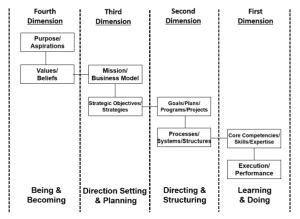
At the most fundamental level is the Learning and Doing dimension. It is the dimension in which things get done and we learn as we move forward. This is how we execute, how we perform, how we measure up to critical KPIs. It is also about continuous learning, developing critical skills and competencies, and reaching levels of expertise as needed. In today’s world with the advent of AI, it is also about developing those skills and competencies within the organization’s AI systems as they perform more and more work formerly performed by humans.
Above that is the Directing and Structuring dimension. It is focused on developing and refining the processes, systems, and structures – the infrastructure – that is needed to perform the day-to-day operations. It also includes the shorter-term goals and action plans along with the programs and projects needed to direct the operations.
At the next highest level is the Direction Setting and Planning dimension. At this level, the mission essentially defines the business and outlines what arena in which it will compete. The business model defines how it will be serving the customer and generating its profits. The key strategies outline the strategic direction the business is taking.
At the highest level is the Being and Becoming dimension. It describes why the company exists and its future aspirations. Its values and beliefs contribute to success and form the foundation of the company’s culture.
The successful implementation of the elements in the First and Second Dimensions are critical for near-term survival and success. The successful implementation of the elements in the Third and Fourth Dimensions are critical for long-term success, health, and sustainability of the organization.
As you move to the right on this model, change occurs more frequently. As you move to the left, less frequently. It is important to note, however, that change can and will occur in every element of this framework.
Element interrelatedness
It is important to understand the positioning of these elements in this model. Fundamentally, as you proceed down and to the right, each element answers the question of “How?” The Strategic Objectives and Strategies answer the question of how you plan to implement your mission and business model. The operational plans, programs, and projects answer the question of how you plan to achieve your strategies and objectives and so on. It is a cascading phenomenon.
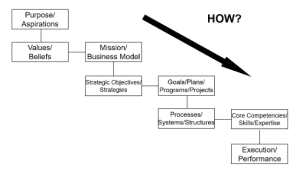
In a likewise manner, as you move to the left and up, each next element as you proceed up the staircase should answer the question of “Why?” Why do you need certain competencies? You need them to operate the various processes and systems? Why do you need those particular processes? You need them to achieve your operational plans and programs. Why do you need those operational plans? You need them to achieve your strategies and objectives.
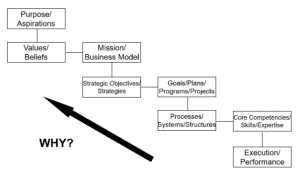
You begin to see, as you use this framework, how the various elements in business interrelate and how they are interconnected.
Reinvention Alignment
Reinvention always requires major change. It can occur in any of these dimensions within any of its elements. What we observe, however, is that major changes will be made in one of these elements without considering the changes needed in interconnected elements.
We will, for example, see a major shift in strategy. However, the management team does not consider how the business model no longer fully aligns with that shift in strategy (the “Why” direction). Beyond that, they will not consider the long-established values and beliefs, the foundation of the organization’s culture, that may work against this change in strategic direction.
When a change in strategy is made, managers are somewhat accustomed to looking at needed changes in their operating plans (the “How” direction) to support a strategy. However, they don’t always look further down the chain at needed changes in their key processes and systems to support the change in strategic direction. They are even less likely to examine the new skills and competencies that may be needed to successfully implement the change.
Hierarchy of Needs
Most people are familiar with Maslow’s Hierarchy of Needs – a hierarchy of needs that humans need to fulfill to survive, be healthy, and ultimately achieve self-actualization. While we don’t want to overstretch the analogy, this organizational framework, when put into a hierarchy pyramid can be thought of as a hierarchy of needs for organizations. Successful implementation of this hierarchy is necessary for survival, for good health, and sustainability in ultimately achieving an organization’s purpose.

Understanding this model is critical for reinvention success because it serves as a critical guide for aligning the organization to the major transformation that results from a reinvention initiative.